

Bilingual Education
Bilingual education is most effective when families, the school and the wider community see it as good for students to learn a second language and to become confident in two languages. This is called an "additive" approach, because students are "adding" a second language rather than replacing one language with another. This is the approach that we will be using at TKP. Research shows that additive approaches are very effective educationally and result in students becoming bilingual as well as biliterate – being able to read and write in two languages.
The research also highlights that becoming biliterate is one of the keys to academic success. Students who are biliterate are more likely to succeed academically and also often outperform students in English-medium schools. Of course, they also end up knowing two languages rather than just one.
Advantages of being Bilingual
Learning two or more languages has many advantages. Some of these advantages currently publicised are:
- Wider communication ability (extended family, community, international links, employment)
- Literacy in two languages.
- Broader understanding of cultures, a deeper multi-culturalism, and two “language worlds” of experiences.
- Greater tolerance and less racism
- Thinking benefits (creativity, sensitivity to communication)
- Raised self-esteem
- Security in identity
- Increased curriculum achievement (higher academic skills)
- Easier to learn a third language
- Future economic and employment benefits
Rumaki
Teena koutou e te whaanau,
Nei raa te mihi o te roopu rumaki o Te Kauwhata kia koutou katoa.
He roopu rumaki maatou e noho ana i raro i te korowai o Ngaa Maramara o ngaa Muka,
E aroha ana maatou ki ngaa mahi a kui maa, a koro maa kaatahi ko ngaa akoranga o te ao hurihuri nei.
Ko te aronga matua o te rumaki, he whakawhanake i ngaa puumanawa o aa maatou tamariki i raro i te maru o te reo me ngaa tikanga Maaori. He taiao haumaru, he taiao ngaakau Maaori, e poipoi ana i te maatauranga, te tuakiri, me te uukaipootanga o ia aakonga.
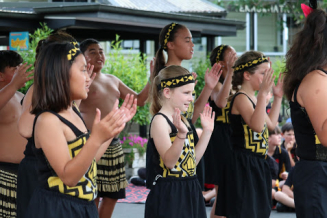
I roto i te waahanga rumaki, ka kuhu ngaa tamariki ki te reo Maaori i ngaa waa katoa o te raa, mai i te akoranga paangarau me te puutaiiao, tae atu ki te toi, te haka, me te oranga tinana. Ko taa maatou whaainga, he whakatupu i ngaa aakonga kia tuu pakari hei uri whakatupu moo aapoopoo, e maia ana ki te koorero Maaori, e maarama ana ki te ao Maaori, e uu ana ki too raatou tuakiri.
Te Kauwhata Primary offers a high quality maaori immersion program (rumaki). We welcome everyone keen to immerse themselves and their child in Maaori language and customs.
Class instruction is in Maaori and all curriculum areas are covered.
The main focus of our immersion programme is to grow the abilities of our children under the shelter of the Māori language and tikanga. It is a safe environment, a Māori-centred space that nurtures learning, identity, and belonging for every student.
Within the immersion area, children are surrounded by the Māori language throughout the entire day — from mathematics and science learning, through to the arts, haka, and physical education. Our goal is to grow learners who stand strong as future generations, confident in speaking Māori, knowledgeable in the Māori world, and grounded in their identity.
“Maaku anoo e hanga tooku nei whare, ko ngaa pou o roto, he maahoe, he patatee he hiinau. Me whakatupu ki te hua o te rengarenga, me whakapakari ki te hua o te kawariki”
Some websites to support our teaching and learning:
Te Reo Maori in English Medium Schools